
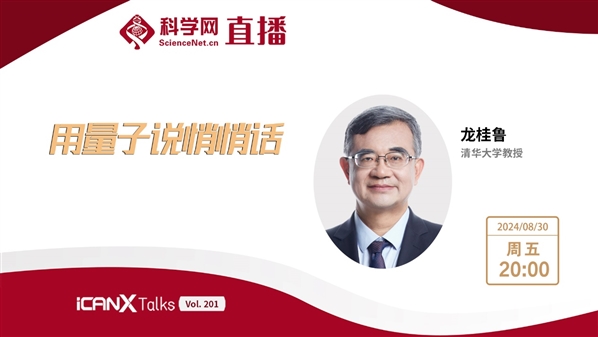
直播时间:2024年8月30日(周五)20:00——21:30
直播平台:
科学网APP
https://weibo.com/l/wblive/p/show/1022:2321325073131739152665
(科学网微博直播间链接)
科学网微博

科学网视频号
【直播简介】
北京时间2024年8月30日晚八点,iCANX Talks 第201期我们邀请到了清华大学龙桂鲁教授作为主讲嘉宾,玻色量子发起人和CEO文凯、北京量子信息科学研究院副研究员王敏也将同时带来分享!此外,北京邮电大学王铁军教授、北京大学助理教授彭湃担任研讨嘉宾,北京大学张海霞教授担任主持人。
这将是一场汇聚顶尖学者的盛会,共同探讨前沿科技与学术挑战!更多精彩,敬请期待!
【嘉宾介绍】
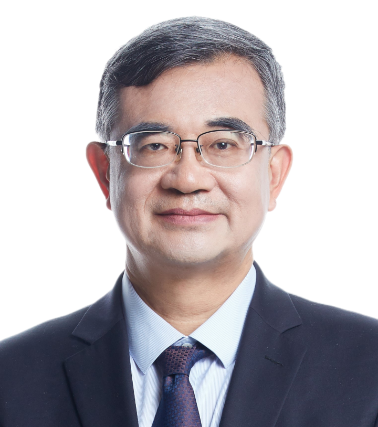
Gui-Lu Long
清华大学
Whispering Using Quantum
[ABSTRACT]
Information security is more important than ever in modern societies, from national security to personal bank account, from security of auto-driving to personal medical data. As quantum computing is developing fast, the day when existing encryption become useless is coming near. Aainst this background, quantum communication appears as a solution to this threat. One well-known quantum communication is quantum key distribution (QKD), which agrees a random key between distant users, and then these keys are used in classical encryption, for instance the one-time-pad scheme. Another quantum communication, quantum secure direct communication (QSDC) is to transmit information directly using quantum states. QSDC was proposed by the speaker in 2000, and is undergoing rapid development in recent years. Its basic principle is to use the principles of quantum mechanics to perceive eavesdropping and design protocols that prevent eavesdroppers from obtaining the information. It is whispering using the quantum world principle. QSDC is whispering and thus is stealthy. It is compatible with existing internet, and hence flexible in application. In this talk, we will talk briefly the QSC principle and recent development.
在现代社会,从国家安全到个人银行账户,从自动驾驶到个人医疗数据,信息安全比以往任何时候都更加重要。随着量子计算的快速发展,现有加密变得无用的那一天即将到来。在这种背景下,量子通信作为一种解决方案出现了。一个众所周知的量子通信是量子密钥分配(QKD),它在遥远的用户之间同意一个随机密钥,然后这些密钥被用于经典加密,例如一次一密方案。另一种量子通信,量子安全直接通信(QSDC)是利用量子态直接传输信息。QSDC由演讲者于2000年提出,近年来发展迅速。其基本原理是利用量子力学原理感知窃听,设计防止窃听者获取信息的协议。它在用量子世界原理窃窃私语。QSDC是耳语,因此是秘密的。它与现有的互联网兼容,因此应用灵活。在本次讲座中,我们将简要介绍QSC原理及其最新发展。
[BIOGRAPHY]
Guilu Long, Professor at Tsinghua University, Vice President of Beijing Academy of Quantum Information Sciences, winner of National Outstanding Youth Fund, winner of special allowance of the State Council, national outstanding scientific and technological researcher, supervisor of Chinese Physical Society, member of the Working Group on Quantum Science and Technology of International Union of Pure and Applied Physics (IUPAP), member of the Future Committee of World Economic Forum (WEF), director of quantum communication commission of china institute of communications, deputy director of Quantum Cryptography Committee of Chinese Cryptography Society, and fellow of Institute of Physics and American Physical Society. Bachelor of Science, Shandong University (1982), Doctor of Science, Tsinghua University (1987). He began to teach in Tsinghua University since1987 and did postdoctoral research at Sussex University in England from 1989 to 1993. He put forward the theory of quantum secure direct communication, led the team to develop the world’s first prototype and practical system, and successfully applied it in banking and 5G special network; constructed the Long algorithm of quantum exact search, proposed the. Duality, or linear combination of unitary, quantum computing paradigm. He has won the second prize of National Natural Science Award, Rao Yutai Award of Chinese Physical Society, IBM Global Faculty Award, Natural Science Award of Ministry of Education, Science and Technology Award of Chinese Institute of Electronics, and the first prize of china institute of communications Science and Technology Award..
龙桂鲁,清华大学教授,北京量子信息科学研究院副院长,国家杰出基金获得者、国务院特殊津贴获得者、全国优秀科技工作者,中国物理学会监事,国际纯物理与应用物理联合会(IUPAP)量子科技工作组委员,世界经济论坛(WEF)未来委员会委员,中国通信学会量子通信委员会主任,中国密码学会量子密码专委会副主任,英国物理学会和美国物理学会会士。山东大学理学学士(1982),清华大学理学博士(1987)。1987起在清华大学从教,1989-1993在英国Sussex大学做博士后研究。他提出了量子直接通信理论,率领团队研制国际首台样机和实用化系统,并成功试用;构造了量子精确搜索的龙算法;提出了对偶量子计算范式。获国家自然科学奖二等奖,中国物理学会饶毓泰奖,IBM全球杰出学者奖,教育部自然科学奖、中国电子学会科技奖、中国通信学会科技奖一等奖各1项。
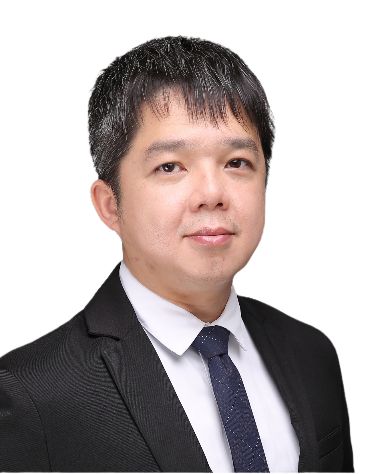
Kai Wen
玻色量子发起人和CEO
Quantum Computer Hardware and their potential Applications
[ABSTRACT]
In this talk, the development of quantum computers and their potential applications are summarized, and three types of photonic quantum computing machines are detailed, including photonic quantum machines, coherent Ising machines (CIMs), and programmable photonic quantum omputers. The following sections of this talk also discuss the threat posed by the development of quantum computing to modern cryptography, as well as the recent progress in quantum computing.
此次演讲介绍了量子计算机的发展及其潜在的应用,并介绍三种光量子计算机,包括光子量子机器、相干伊辛机器(CIM)和可编程光子量子计算机等。本次演讲还将讨论量子计算对现代密码学的威胁,以及量子计算方面的最新进展。
[BIOGRAPHY]
Dr. Wen Kai is the founder and CEO of Beijing QBoson Quantum Technology Co., Ltd., and the Principal Investigator (PI) Researcher at the Quantum Science Center of Guangdong-Hong Kong-Macao Greater Bay Area. He holds a bachelor’s and master’s degree from Tsinghua University and a Ph.D. in Electrical Engineering from Stanford University, where he studied under Professor Long Guilu and Professor Yoshihisa Yamamoto, a pioneer in quantum optics and quantum information. Dr. Wen Kai has made pioneering achievements in the field of coherent quantum computing, becoming the first Ph.D. in this field globally, and has published numerous top-tier papers and patents. Since founding QBoson company in 2020, Dr. Wen Kai has focused on the research and development of practical quantum computing devices, committed to the engineering realization and application exploration of coherent optical quantum computing devices. In May 2023 and April 2024, he successively achieved and released 100-qubit and 550-qubit Coherent Ising Machines (CIM), reaching an internationally leading level, and successfully carried out application exploration and real-machine verification in fields such as finance, transportation, communication, and biopharmaceuticals. Dr. Wen Kai currently serves as the PI of the Precision Optics Laboratory at the Quantum Science Center of Guangdong-Hong Kong-Macao Greater Bay Area, Executive Committee Member of the Quantum Computing Professional Committee of the China Computer Federation (CCF), Committee Member of the Quantum Communication Professional Committee of the China Institute of Communications (CIC), External Expert of China Mobile Cloud Centre and Editorial Board Member of the Fundamental Research journal by the National Natural Science Foundation of China (NSFC).
文凯博士,北京玻色量子科技创始人&CEO,粤港澳大湾区(广东)量子科学中心PI研究员,清华大学本硕,美国斯坦福大学电子工程系博士,师从龙桂鲁教授和量子光学和量子信息泰斗Yoshihisa Yamamoto(山本喜久)教授。文凯博士在相干量子计算方向上做出了开创性的成就,成为该领域在全球范围内首位博士,已发表多篇顶级论文和专利。文凯博士于2020年创立玻色量子至今,聚焦实用型量子计算设备研发,致力于相干光量子计算设备的工程化实现及应用探索。2023年5月和2024年4月先后已实现并发布100量子比特和550量子比特相干光量子计算机,达到国际领先水平,并金融、交通、通信、生物制药等领域成功展开应用探索和真机验证。文凯博士现任粤港澳大湾区(广东)量子科学中心精密光学实验室PI,中国计算机学会量子计算专业委员会执行委员、中国通信学会量子通信专业委员会委员、中国移动云能力中心外聘专家,国家自然科学基金委Fundamental Research期刊编委。
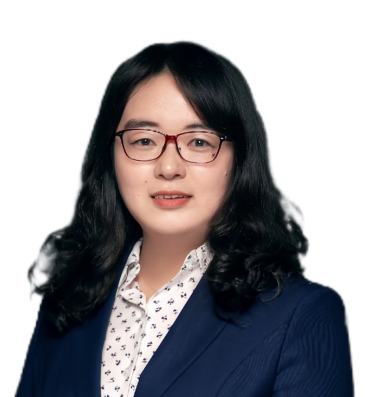
Min Wang
北京量子信息科学研究院
Progress of Quantum Network
[ABSTRACT]
Quantum networks represent an extension and enhancement of classical networks, which enable secure information storage and transmission, efficient information processing, and high-precision remote sensing, among other capabilities. This report will provide an overview of the frontier research area of quantum networks from multiple perspectives, including the foundational principles of quantum mechanics, quantum technologies, network components, network design, and quantum applications. It will analyze the key technical challenges faced in this field and highlight potential future research directions in network design.
量子网络是经典网络的扩展与完善,利用量子网络可以实现安全的信息存储和传输、高效的信息处理和高精度的远程传感等。本报告将从量子力学基础原理、量子技术、网络组件、网络设计、量子应用等多个角度对量子网络这一前沿性研究领域进行了介绍,分析该领域所面临的关键技术挑战,并指出该领域在网络设计方面的未来研究方向。
[BIOGRAPHY]
Min Wang is an Associate Research Scientist at Beijing Academy of Quantum Information Sciences. She received her B.S. degree from Fudan University in 2013, and PhD degree from Tsinghua University in 2019, and then worked in Tsinghua University as a postdoctoral fellow, before joining Beijing Academy of Quantum Information Sciences in 2021. Her research is focused on quantum communication and nano-photonics. She has published more than 30 papers in Laser & Photonics Reviews, Photonics Research, Optics Letters and other academic journals, and authorized 5 patents for invention. She received the Young Elite Scientists Sponsorship by China Association for Science and Technology in 2022, and the Second Prize of Fintech Development Award from Peoples Bank of China in 2023.
王敏,现任北京量子信息科学研究院副研究员。2013年获复旦大学学士学位,2019年获清华大学物理学博士学位,后在清华大学物理系从事博士后研究工作,2021年加入北京量子信息科学研究院,从事量子通信和微纳光学研究。在 Laser & Photonics Reviews、Photonics Research、Optics Letters等学术期刊上发表论文30余篇,授权发明专利5项。2022年入选中国科协青年人才托举工程,2023年获得中国人民银行金融科技发展奖二等奖。
中国科学技术大学潘建伟、朱晓波、彭承志、龚明等,与山西大学梅锋等合作,基于可编程超导量子处理器“祖冲之2号”,首次在量子体系中实现并探测了高阶非平衡拓扑相(Higher-OrderNonequilib......
生物计算是指利用生物系统固有的信息处理机理研究开发的一种新的计算模式。科学家正尝试培养人类神经元,并将其构建成具备“生物晶体管”功能的系统。英国《自然》网站在日前的报道中指出,部分科学家认为,生物计算......
近日,清华大学2025年9至12月政府采购意向发布,本项目采购预算925万元,预计采购的仪器设备包括高光谱成像仪、材料表征系统、数字PCR、定量PCR、恒温扩增核酸分析仪、高通量单细胞标记分选及核酸检......
近日,清华大学实验室管理处对第十五届“清华大学优秀实验技术人员奖”获奖名单进行了公示。在此次公示名单中,化学系/分析中心磁共振实验室的杨海军高工荣获该项殊荣!这一奖项旨在表彰在实验技术岗位上长期耕耘、......
8月21日,清华大学2025级本科生新生开学典礼在该校举行,约4000名新生参加典礼。典礼上举行了新生佩戴清华大学徽章仪式,清华大学校党委书记邱勇为新生代表戴上了清华大学徽章,并激励清华新生心怀梦想、......
据最新一期《科学》杂志报道,美国哈佛大学研究人员开发出一种新型光学器件,即“超表面”,可在单一的平面上完成复杂量子操作。超表面可同时承担多种传统光学元件功能,解决了光子量子信息处理领域长期存在的体积庞......
清华新闻网7月8日电日前,上级决定,曾嵘同志任清华大学常务副校长(正局级,试用期一年),吴华强同志任清华大学党委常委、副校长(试用期一年)。新任校领导简介:曾嵘曾嵘,男,汉族,1971年11月生,中共......
近期,清华大学连续发布多项仪器采购意向,预算总金额高达36836.6万元。涉及仪器设备包括红外光谱仪、热重-热常数分析仪、激光扫描共聚焦显微镜、高通量分子互作分析仪、类器官代谢监测仪、冷冻超薄切片系统......
近日,清华大学水利水电工程系教授龙笛团队在全球地表水体遥感监测研究中取得重要进展。该团队研究成果成功揭示了全球百万湖泊水域面积的多尺度动态与季节性主导机制,在世界范围内打破了长期困扰遥感水文界的“时间......
5月30日,清华大学无穹书院、紫荆书院、自强书院、水木书院成立仪式暨书院院长聘任仪式在主楼接待厅举行。这是清华大学坚持以进一步全面深化改革激发内在活力,面向国家重大战略需求和经济社会发展需要,把传统工......