
We have found that the DNA extraction procedure of Metzenberg and Baitch (Neurospora Newsl. 28:20)/Stevens and Metzenberg (Neurospora Newsl. 29:27) while giving excellent yield and size of DNA, is somewhat cumbersome and also results in the occasional sample that proves to be uncuttable. We report here a simple method for growing Neurospora and for isolation of DNA that may be performed in two days from start to finish. The growth of mycelia in Petri plates (suggested by G. May) eliminates the need for large numbers of flasks when growing many cultures for DNA isolation.
1. Inoculate plastic Petri plates containing 25 ml of 1X Vogels, 2 sucrose, 0.04 Tween-80 (to prevent conidiation) (Zalokar, M. 1954. Arch. Biochem. Biophys. 50:71-80) plus any other required supplements. We use a loopful of conidia from a 5-10 day old tube. Incubate at 33°C. Handle the plates carefully to prevent spillage.
2. Harvest the mycelia by filtration after 36-48 h, rinse with distilled water and remove excess water by briefly pressing the pad between paper towels. Lyophilize for at least 2 h.
3. Grind the lyophilized pad in a 1.5 ml microfuge tube or a 15 ml conical tube using a metal rod or a spatula.
4. Add 1 ml of extraction buffer to the tube containing the mycelial powder and mix gently. Let stand at room temperature. for 20 min.
5. Transfer the homogenate to a microfuge tube and centrifuge in a microfuge for 5 min.
6. Recover supernatant and transfer to a tube containing 1 ml of diatomaceous earth (DE) in 6M Guanidine Thiocyanate. Let this stand at room temperature. for 2-3 min.
7. Decant into a spin column (either a 3 cc syringe body plugged with siliconized glass wool or a prefabricated spin column) and filter by aspiration. Rinse 3 times with 2 ml of 80 isopropanol. Continue aspiration for 2 min to dry out the DE. We use a standard 1 liter filter flask with a #8 stopper drilled with 5 small bore holes. Ten samples can be filtered simultaneously by using two flasks from one aspirator with a Y-junction. Commercial manifolds are also available.
8. Place each column into a 15 ml conical tube with the tip of the column resting inside a 0.5 ml microfuge tube at the bottom of the 15 ml tube. Add 150 ul of ddH20 at 65°C and spin in a tabletop centrifuge at maximum speed for 1 minute. Add an additional 150 µl and repeat.
Extraction Buffer
2M NaCl
0.4 Deoxycholic acid (sodium salt) Sigma D-6750
1.0 Brij 58 (polyoxyethylene 20 cetyl ether ) Sigma P-5884
DE/GTC
8.5 g of acid washed diatomaceous earth (Sigma D-5384), added to 100 ml of 6M Guanidine Thiocyanate (ultrapure, BMB)
Stable for approximately 6 months at room temperature.
The yield of DNA varies from 5-30 µg depending upon the amount of mycelium that is harvested. The quality of the DNA is high, with the size averaging greater than 20 kb. It digests to completion in 2 h, and has been used in Southern blots (Figure 1) and for PCR applications. The DNA is more dilute than in typical extraction procedures, but may easily be concentrated by lyophilizing or by precipitation.
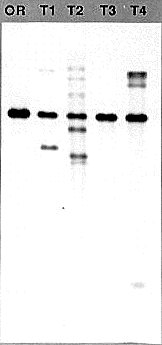
Figure 1 Genomic Southern blot analysis using DNA prepared with the Metzenberg procedure (OR, strain Oak Ridge 74-OR23-1VA) and DNAs prepared with the procedure described above (Transformants T1-T4). The visible bands range in size from >12 kb to 500 bp. One microgram of each of the DNAs was digested for 2h at 37°C with 5 units of HindIII in the manufacturers supplied buffer in a volume of 40 µl. The DNAs were fractionated overnight in a 0.7 agarose gel in 1X TAE buffer. After transfer to nylon membrane, the DNAs were probed with the transforming DNA fragment that was labeled by the random hexamer priming method. The probe is a 2.3 kb HindIII to BamHI fragment from linkage group VI, cloned from a strain where it forms a translocation junction with linkage group V just upstream of the am gene.
荷兰乌得勒支大学研究人员开发出一款全新荧光传感器,可在活细胞乃至活体生物中实时监测DNA损伤及修复过程,为癌症研究、药物安全测试和衰老生物学等领域提供了重要的新工具。相关成果发表于新一期《自然·通讯》......
三维基因组互作与表观遗传修饰是基因表达调控的重要因素,其动态变化与细胞生长发育及癌症等疾病的发生发展密切相关。解析染色质在活细胞内的时空动态,是理解基因调控机制的重要科学问题。现有基于CRISPR-C......
1812年,法国皇帝拿破仑一世从俄罗斯莫斯科撤退时,其大部分军队因饥饿、疾病和寒冷的冬天而损失殆尽。如今,对这撤退途中丧生的30万士兵的部分遗骸的DNA的分析发现,两种未曾预料到的细菌性疾病很可能增加......
1812年夏,法兰西皇帝拿破仑·波拿巴率50万大军入侵俄罗斯帝国。然而到12月时,这支军队仅余零星残部。历史记载将此次“全军覆没”归因于饥寒交迫与斑疹伤寒。但一项新研究表示,从士兵牙齿中提取的DNA,......
美国北卡罗来纳大学研究团队研发出一种名为“DNA花朵”的微型机器人。这种机器人具有独特的自适应环境变化能力,能够像生物体一样,根据周围环境改变形状和行为。“DNA花朵”机器人由DNA与无机材料结合形成......
瑞士苏黎世联邦理工学院科学家在最新一期《自然》杂志上发表论文称,他们开发出一款名为MetaGraph的DNA搜索引擎,能快速、高效地检索公共生物学数据库中的海量信息,为研究生命科学提供了强大的专业工具......
究竟是什么让人脑与众不同?美国加州大学圣迭戈分校研究团队发现了一个名为HAR123的小型DNA片段,这将是解开人类大脑独特性之谜的关键。相关研究成果发表于新一期《科学进展》杂志。最新研究表明,HAR1......
究竟是什么让人脑与众不同?美国加州大学圣迭戈分校研究团队发现了一个名为HAR123的小型DNA片段,这将是解开人类大脑独特性之谜的关键。相关研究成果发表于新一期《科学进展》杂志。最新研究表明,HAR1......
基因组编辑技术作为生命科学领域的一项重要突破,为基础研究和应用开发提供了技术支撑。以CRISPR及其衍生技术为代表的编辑系统通过可编程的向导RNA引导Cas9等核酸酶靶向基因组特定位点,被广泛应用于特......
神经元中基因编辑的插图。图片来源:杰克逊实验室哪怕在五年前,人们也会认为在活体大脑中进行DNA修复是科幻小说中才有的情节。但现在,科学家已能进入大脑、修复突变,并让细胞在整个生命周期中维持住这种修复效......