
We have found that the DNA extraction procedure of Metzenberg and Baitch (Neurospora Newsl. 28:20)/Stevens and Metzenberg (Neurospora Newsl. 29:27) while giving excellent yield and size of DNA, is somewhat cumbersome and also results in the occasional sample that proves to be uncuttable. We report here a simple method for growing Neurospora and for isolation of DNA that may be performed in two days from start to finish. The growth of mycelia in Petri plates (suggested by G. May) eliminates the need for large numbers of flasks when growing many cultures for DNA isolation.
1. Inoculate plastic Petri plates containing 25 ml of 1X Vogels, 2 sucrose, 0.04 Tween-80 (to prevent conidiation) (Zalokar, M. 1954. Arch. Biochem. Biophys. 50:71-80) plus any other required supplements. We use a loopful of conidia from a 5-10 day old tube. Incubate at 33°C. Handle the plates carefully to prevent spillage.
2. Harvest the mycelia by filtration after 36-48 h, rinse with distilled water and remove excess water by briefly pressing the pad between paper towels. Lyophilize for at least 2 h.
3. Grind the lyophilized pad in a 1.5 ml microfuge tube or a 15 ml conical tube using a metal rod or a spatula.
4. Add 1 ml of extraction buffer to the tube containing the mycelial powder and mix gently. Let stand at room temperature. for 20 min.
5. Transfer the homogenate to a microfuge tube and centrifuge in a microfuge for 5 min.
6. Recover supernatant and transfer to a tube containing 1 ml of diatomaceous earth (DE) in 6M Guanidine Thiocyanate. Let this stand at room temperature. for 2-3 min.
7. Decant into a spin column (either a 3 cc syringe body plugged with siliconized glass wool or a prefabricated spin column) and filter by aspiration. Rinse 3 times with 2 ml of 80 isopropanol. Continue aspiration for 2 min to dry out the DE. We use a standard 1 liter filter flask with a #8 stopper drilled with 5 small bore holes. Ten samples can be filtered simultaneously by using two flasks from one aspirator with a Y-junction. Commercial manifolds are also available.
8. Place each column into a 15 ml conical tube with the tip of the column resting inside a 0.5 ml microfuge tube at the bottom of the 15 ml tube. Add 150 ul of ddH20 at 65°C and spin in a tabletop centrifuge at maximum speed for 1 minute. Add an additional 150 µl and repeat.
Extraction Buffer
2M NaCl
0.4 Deoxycholic acid (sodium salt) Sigma D-6750
1.0 Brij 58 (polyoxyethylene 20 cetyl ether ) Sigma P-5884
DE/GTC
8.5 g of acid washed diatomaceous earth (Sigma D-5384), added to 100 ml of 6M Guanidine Thiocyanate (ultrapure, BMB)
Stable for approximately 6 months at room temperature.
The yield of DNA varies from 5-30 µg depending upon the amount of mycelium that is harvested. The quality of the DNA is high, with the size averaging greater than 20 kb. It digests to completion in 2 h, and has been used in Southern blots (Figure 1) and for PCR applications. The DNA is more dilute than in typical extraction procedures, but may easily be concentrated by lyophilizing or by precipitation.
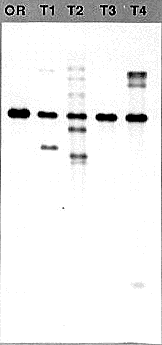
Figure 1 Genomic Southern blot analysis using DNA prepared with the Metzenberg procedure (OR, strain Oak Ridge 74-OR23-1VA) and DNAs prepared with the procedure described above (Transformants T1-T4). The visible bands range in size from >12 kb to 500 bp. One microgram of each of the DNAs was digested for 2h at 37°C with 5 units of HindIII in the manufacturers supplied buffer in a volume of 40 µl. The DNAs were fractionated overnight in a 0.7 agarose gel in 1X TAE buffer. After transfer to nylon membrane, the DNAs were probed with the transforming DNA fragment that was labeled by the random hexamer priming method. The probe is a 2.3 kb HindIII to BamHI fragment from linkage group VI, cloned from a strain where it forms a translocation junction with linkage group V just upstream of the am gene.
美国加州大学圣迭戈分校研究人员利用高通量DNA测序和人工智能技术,解码了人类基因中一段名为“起始子”的关键DNA序列特征。这项成果为解析基因表达调控规律和预测DNA突变影响提供了新工具。相关论文发表于......
1587年10月一个温暖的日子,意大利托斯卡纳大公弗朗切斯科·德·美第奇因高热不治而亡。接诊医生初步判定死因是疟疾,但很快坊间流言四起,不少人猜测他是遭心怀嫉妒的弟弟费迪南多下毒谋害。如今,全新的科学......
迄今规模最大的古代人类DNA研究表明,人类进化在过去1万年里明显加快。这项由美国哈佛医学院的群体遗传学家DavidReich联合主导的研究,4月15日发表于《自然》。研究人员在涵盖欧洲和中东地区的古代......
近日,中国科学院青岛生物能源与过程研究所单细胞中心与中国科学院天津工业生物技术研究所合作,研究开发了一种集成的、高灵敏度且高通量的错误校正平台eMBS。能够通过理性设计工程化MutS蛋白并结合磁珠分离......
据报道,上个月法国发生的一起案件,在一把枪上发现了同卵双胞胎兄弟的DNA,但他们拥有相同的DNA,所以传统的DNA检测方法,无法确定DNA属于哪位兄弟。在法国一起刑事审判中,传统的DNA检测未能区分出......
27日的《科学》杂志发表了一项研究,揭示了人类基因组中一类可“跳跃”的DNA片段——被称为遗传“寄生虫”的LINE-1(L1)元件,如何成为破坏癌症基因组稳定性的主要力量。基因组的不稳定正是癌症演化的......
一艘沉没于150年前的船经历了怎样的航程?科研人员从出水瓷瓶内的沉积物中,“打捞”出了它的生命史。通过对长江口二号沉船出水青花双耳瓶中的土壤沉积物进行环境因子与沉积物古DNA分析,来自复旦大学、华东师......
在近日一项发表于《自然》的研究中,科学家绘制出迄今最详尽的人类活细胞内DNA折叠、环状缠绕和移动的图谱,展示了基因组结构随时间推移的变化情况,揭示了隐藏的基因调控机制,是了解DNA结构如何塑造人类生物......
图基于卷对卷流体的新一代快速低成本基因测序技术在国家自然科学基金项目(批准号:22027805、22334004、22421002)等资助下,福州大学杨黄浩、陈秋水团队与华大生命科学研究院秦彦哲、章文......
荷兰乌得勒支大学研究人员开发出一款全新荧光传感器,可在活细胞乃至活体生物中实时监测DNA损伤及修复过程,为癌症研究、药物安全测试和衰老生物学等领域提供了重要的新工具。相关成果发表于新一期《自然·通讯》......