
Early in embryonic development, the region of the chick embryo which is determined to form a limb first differentiates from the rest of the embryo1. The next step in the formation of the actual limb (wing or leg) is the development of the limb region into a specific set of functional tissues through the interactions of several proteins, or morphogenesis. Morphogenesis of the vertebrate limb occurs similarly in all tetrapods. This similarity is marked by growth in three dimensions which are along the proximal-distal, anterior-posterior, and dorsal-ventral axes.
By the sixth day, the limb bud possesses all the necessary signals to continue growth of the limb in culture and is visible as a process on the embryo with distinct axes. As development continues, the basic limb structure arises out of the limb bud as skin, cartilage, and skeletal muscle. As the embryo matures, the cartilage will turn into bone, thus getting closer to fulfilling the fate which began in the early embryo. In addition to differentiating into basic structure, the limbs differentiate from each other. This differentiation is determined by the interaction of several chemicals and growth factors. As a result, a wing is not the same as the leg. The consequence of normal limb development in the chick embryo are the legs and wings necessary for the organism's survival.
Two methods of limb bud culture exist. Chorioallantioc membrane (CAM) grafting is a culture method commonly used in the past. In this type of experiment, the severed limb bud is grafted into a host egg on a Y- shaped junction of blood vessels. The limb grows on nutrients supplied by the host egg. A more recent application of limb bud uses no host but a growth medium in vitro. The culture medium contains elements essential for continued growth and antibiotics to protect against infection. Although CAM grafts have been used in the past, an obvious advantage of an in vitro method is that manipulative agents, such as growth factors and hormones, can be added to the culture medium.
The primary purpose of this experiment is to observe limb development by studying the presence of cartilage in cultured limbs. The secondary purpose is to investigate whether or not in vitroculture can support limb development. The control will be limbs that develop in ovo.
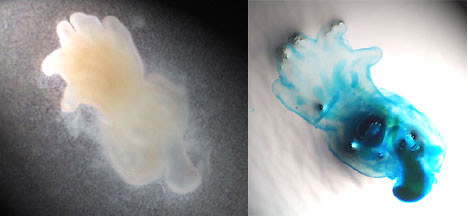
Limbs developed in vitroand cartilage was observed using Alcian green staining. In some cases, development had progressed to the point at which cartilage began changing into bone, and, thus, was not seen in the staining. Compared to control limbs, limbs grown in media were not as large or organized as well.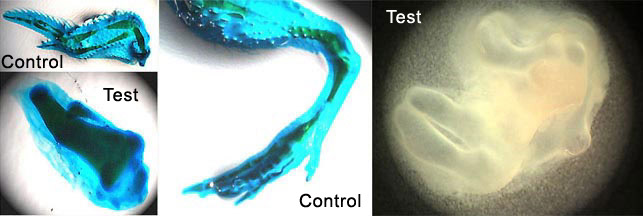
Detailed Laboratory Procedures2 Week 1: Preparation and culture of the limb bud.
1. In 6 well plates, place tissue culture filter inserts over approximately 1.8ml of culture media. | |||||
Week 2: Staining for limb cartilage. | |||||
1. Fix limbs in 5% TCA for 1 hour at room temperature. Culture media:
|
万物蓬勃的7月里迎来了2022年ANTOP奖的申报和评审工作。由岛津企业管理(中国)有限公司申报的“3CoinONE全新体验气袋进样器”ANTOP奖进入专家评审阶段。奖项名称:3CoinONE全新体验......
青岛青源峰达太赫兹科技有限公司研发团队在国际顶级期刊《TrendsinBiotechnology》(译名:《生物技术趋势》)在线发表题为“THzmedicalimaging:frominvitroto......
安进宣布,美国FDA授予其在研firstinclass单抗bemarituzumab突破性疗法认定,与改良FOLFOX6化疗方案(亚叶酸钙、氟尿嘧啶和奥沙利铂)联用,一线治疗FGFR2b过表达和HER......
2007年,中国科学院金属研究所研究员张志东在英国《哲学杂志》(PhilosophicalMagazine)上发表论文,提出两个猜想,并在猜想基础上推定出三维伊辛模型的精确解。被《哲学杂志》审稿人评价......
《NatureChemicalBiology》杂志在线版一篇文章介绍,伊利诺斯州立大学JohnA.Gerlt博士率领的研究小组研制出一种新途径,能够确定氨基酸序列已知的蛋白的结构和功能。这是首次利用计......
摘要:本实验用HCl-HNO3-HF-HClO4消解样品,KI2MIBK萃取火焰原子吸收分光光度法连续测定土壤样品中的痕量Cd、Tl、In、Ag。方法检出限:镉为0.0052μgPg,铊为0.0156......