
The chicken is a classic organism used to illustrate the principles of basic embryology. One of the developmental systems which has been examined in great detail is the circulatory system. In the developing embryo, the circulatory system is the first functional unit and the heart is the first functional organ. The heart of the chicken embryo develops from the fusion of paired precardiac mesodermal tubes, forming a straight anterior to posterior ventricular tube. After fusion is complete, the heart tube has four distinct regions:bulbus cordis, ventricle, atrium, and sinus venosus. Pulsations in the heart starts while the paired primordial cells fuse. The sinus venosus is the pacemaker of these initial contractions (Gilbert 1997).
After approximately 33 hours the heart tube bends to form an "S" shape structure with a single atrium and a single ventricle. By 2 days the heart has folded upon itself forming a single loop. This moves the sinus venosus and atrium to a position anterior and dorsal to the ventricle and the bulbus cordis. In 3 day-chick embryos, the atrium has begun to expand to the left in preparation of the division into the right and left atria. Although the heart still has two chambers at this time, communication between the sinus venosus and the atrium occurs through the right side of the atrium. Times of development may vary. Eventually, when the atrium and ventricle divide to develop a typical four-chambered heart, the sinus venosus will be incorporated into the right atrium. The bulbus cordis will eventually give rise to the aorta.
In this experiment, we will remove hearts from 2-day and 3-day chick embryos (see below) and maintain them under specific conditions which allow for their development. By this time the two chambered heart should be visible as well as the blood flow entering the lower chamber and being pumped out through the aorta. The goals of this lab are:to identify the anatomy of the developing chick heart, determine the direction of blood flow through the developing heart, and to observe how the heart develops over time.
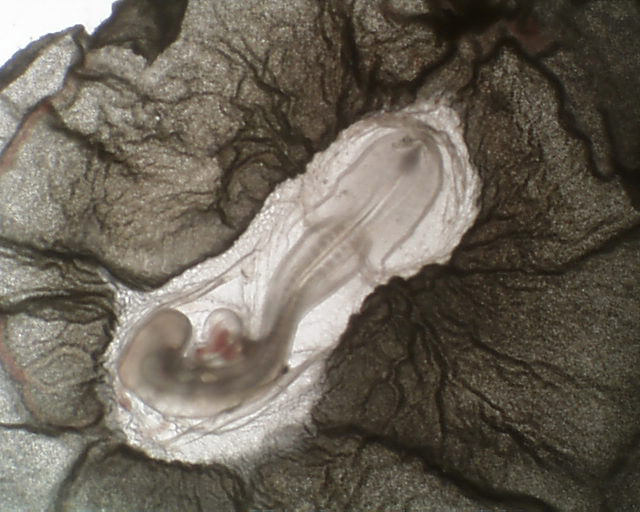
3 day chick embryo heart donor
Major Observations
All the 2 day hearts stopped beating after the first day of removal. However, the 3 day hearts continued to develop and beat in culture for approximately 2 days after removal. Therefore, Looping and thickening of the atrium can be observed as well as the direction of blood flow (see movie below).
Howard Ringer's solution
7.2 gNaCl
0.17 gCaCl2(anhyd.) or .23 g CaCl2.2H2O
0.37 gKCl
add dH2O to 1 liter
万物蓬勃的7月里迎来了2022年ANTOP奖的申报和评审工作。由岛津企业管理(中国)有限公司申报的“3CoinONE全新体验气袋进样器”ANTOP奖进入专家评审阶段。奖项名称:3CoinONE全新体验......
青岛青源峰达太赫兹科技有限公司研发团队在国际顶级期刊《TrendsinBiotechnology》(译名:《生物技术趋势》)在线发表题为“THzmedicalimaging:frominvitroto......
蛋白质作为构成人体组织器官的支架和主要物质,在人体生命活动中起着重要作用。蛋白质的相互作用能产生许多效应,如形成特异底物作用通道、生成新的结合位点、失活、作用底物专一性和动力学变化等,细胞的代谢、信号......
2021年9月9日,无锡臻和生物科技有限公司(以下简称“臻和科技”)与美国VyantBio公司签署TissueofOrigin®(以下简称“TOO®”)全球权益和ZL转让协议,全资收购这款唯一获FDA......
2021年7月20日,JournalofCellularPhysiology及JournalofCellularBiochemistry同时撤回了中国学者49篇文章。从2019年开始,Journalo......
安进宣布,美国FDA授予其在研firstinclass单抗bemarituzumab突破性疗法认定,与改良FOLFOX6化疗方案(亚叶酸钙、氟尿嘧啶和奥沙利铂)联用,一线治疗FGFR2b过表达和HER......
2007年,中国科学院金属研究所研究员张志东在英国《哲学杂志》(PhilosophicalMagazine)上发表论文,提出两个猜想,并在猜想基础上推定出三维伊辛模型的精确解。被《哲学杂志》审稿人评价......
磷酸甘油酸突变酶1(PGAM1)通过其代谢活性以及与其他蛋白质(例如α平滑肌肌动蛋白(ACTA2))的相互作用,在癌症代谢和肿瘤进展中起关键作用。变构调节被认为是发现针对PGAM1的高选择性和有效抑制......
科技巨头苹果公司已经不再满足于智能手机市场了。因为在天量的医疗健康市场面前,手机市场显得太小了。在几番试水之后,苹果公司似乎找到了在医疗市场充当颠覆者的杀手锏。全球医疗健康领域约7万多亿美元的市场(接......
2018年12月6日,来自圣迭戈的消息——Illumina公司(纳斯达克股票代码:ILMN)今天宣布推出新型高密度基因分型芯片Infinium™GlobalDiversityArray。这款芯片设计源......