
Objective
The purpose of this experiment is to observe the effect of caffeine on the heart rate of three day old chick embryos by directly treating them with five different concentrations of caffeine.
Introduction
The first functional organ of chick embryos is the heart (Gilbert, 2003). At three days, chick embryos already have a tubular heart structure with one atrium and one ventricle, (Gilbert, 2003). As the circulatory system is the first to develop, the heart does not rely on external innervations to initiate contractions. Heart muscle cells are intrinsically rhythmic and pulsate in unison by releasing electrical signals.
These signals depend on a sodium-calcium gradient (created by a Na+-Ca++ exchange pump) and calcium channels (Bellairs, R. and Osmond, M. 1998). Nevertheless, other signaling molecules, such as acetylcholine and norinephrine can affect embryonic hearts (Gilbert, 2003). Due to the importance of the circulatory system, morphological changes caused by signals and external chemicals, such as caffeine, have the potential to cause irreversible harm on a developing embryo. Figure 1. A three-day-old chick embryo, with visible circulatory system and somites. However, previous studies have shown that, in addition to inducing cardiovascular mutations in embryonic chicks, caffeine also has immediate effects on the embryo. Exposure to increasing levels of caffeine increase heart rates, decrease the forcefulness of each contraction, and at higher levels of caffeine, so much that the hearts stop beating. The purpose of this study was to examine the effects of five different concentrations of caffeine on the heart rates of embryonic chicks that were three days old. It was expected that the increase in heart rates would be proportional to the concentration of caffeine to which the heart was exposed.
Caffeine increases the teratogenic effects of ephedrine on embryonic chick hearts (Nishikawa, 1985). Although it is not known exactly how caffeine effects an embryo on a molecular level, embryos have not yet developed the succession of liver enzymes present in adults that are needed to degrade caffeine (Braun, 1996).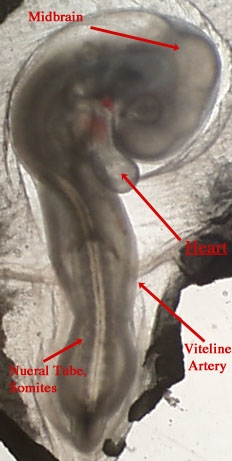
Procedure
Preparation: Prep sheet
1) Warm Dulbecco's modified Eagle Medium (DMEM, Sigma) andHoward's Ringers solution to 37 degrees C. Diliute the 1 mg/ml stock caffeine solution in DMEM.
2) Pour solutions into five 2 ml plastic dishes. Solutions: Howard Ringers Solution, DEM, caffeine solutions: 0.1 mg/ml. 0.2 mg/ml, 0.3 mg/ml.
3) An additional 2 dishes should be filled with warmed Howard Ringers solution for additional group controls.
4) Make a chart for recording the heart beats that includes the following information:
Egg # | |||||||
Howard Ringers solution | Base (DMEM) | 0.1 mg/ml Caffeine | 0.2 mg/ml Caffeine | 0.3 mg/ml Caffeine | 0.5 mg/ml Caffeine | 1.0 mg/ml Caffeine | |
. . |
5) Take the eggs out of the incubator and place in Styrofoam tray on the bench.
Removal of the heart:
6) Using the fine forceps, remove the trunk region of the embryo above and below the heart.
7) Remove the heart region, leaving the heart intact and place the heart in a dish of Howard Ringers solution.
8) Try to record at least 3 or 4 hearts.
9) The beats of each heart should be recorded for a minute in one of the solutions containing caffeine and the controls.
Protocol sheet (Lab Handout)
Three-day-old chick embryos used in this study were divided into two groups, labeled A and B. The hearts in group A were placed in DMEM , then caffiene solutions 0.1 mg/ml, 0.5 mg/ml and 1.0 mg/ml successively. Hearts in group B were added to HR, DEM and caffeine solutions 0.1 mg/ml, 0.2 mg/ml and 0.3 mg/ml.
Results
As each heart beat at a different rate in Dulbecco's Eagle Medium, the number of beats produced in the DMEM control after one minute was used as the base rate (BR) for each heart. The base rates were consistently higher than those obtained in Howard Ringers (HR) Solution (Table 1). All hearts in both groups beat faster than their base rates when transferred to the 0.1 mg/ml caffeine solution (Tables 1, Table 2). The 0.2 mg/ml caffeine solution further increased beats per minute in group B (Table 1). The 0.3 mg/ml caffeine solution caused the hearts to beat above the base rate, but it clearly did not have as great an effect on the hearts as the solutions with lower concentrations of caffeine.
Table 1. The heart beats per minute of each heart tested in DMEM, HR solution and the caffeine solutions of concentrations 0.1mg/ml, 0.2 mg/ml and 0.3 mg/ml. The reaction of each heart to the various solutions is also shown as the percentage of the base rate (DMEM).
Group B | DMEM | HR | 0.1 mg/ml | % of BR | 0.2 mg/ml | % of BR | 0.3 mg/ml | % of BR |
Heart 1 | 72 | 36 | 78 | 108.3 | 84 | 116.7 | 66 | 91.7 |
Heart 2 | 65 | 41 | 78 | 120.0 | 70 | 107.7 | 68 | 104.6 |
Heart 3 | 38 | 36 | 37 | 97.4 | 45 | 118.4 | 46 | 121.1 |
Group A tested the effects of the higher caffeine concentrations, 0.5mg/ml and 1.0 mg/ml (Table 2). Dosages of 0.5 mg/ml caffeine decreased the heart rates below that of the base rate. When the hearts were placed in an even higher concentration of caffeine, the 1.0 mg/ml caffeine solution, beating ceased.
Table 2. The results of Group A, the average number of beats per minute when the four hearts were placed in DMEM control, and three caffeine solutions of concentrations 0.1mg/ml, 0.5 mg/ml and 1.0 mg/ml.
Group A | Average Number of bpm | Percentage of BR |
DMEM (base rate) | 32 | 100 |
0.1 mg/ml Caffiene | 43 | 134.4 |
0.5 mg/ml Caffeine | 19 | 59.4 |
1.0 mg/ml Caffeine | 0 | 0.0 |
Discussion
As predicted, the hearts beat faster in DMEM than in HR; this is pobably due to the presence of glucose as an energy source in the DMEM. Also consistent with our expectations, dilute caffeine solutions (0.1 mg/ml and 0.2 mg/ml) did further increase the heart rates relative to the base rate (see table 3). However, we did not expect that higher dosages of caffeine (0.3-1.0 mg/ml) would increase the heart rates to a lesser extent than the lower concentrations of caffeine and eventually cause the hearts to stop beating (see figure 11).
Table 3. The average number of beats per minute in each solution produced by all the hearts (groups A and B). The average bpm of groups A and B combined in each solution are also shown below as a percentage of the base rate.