
Human-pathogenic fungi such as Coccidioides immitis and Histoplasma capsulatum must be handled in Biosafety level 3 containment facilities which make for a very awkward working environment (J.Y. Richmond and R.W. McKinney, eds. Biosafety in Microbiological and Biomedical Laboratories, 3rd ed. NIH, Washington). In this paper we describe a safe and convenient method of extracting DNA from such fungi in which the culture is killed by steaming, allowing removal from the containment facilities, as soon as possible. The method was first developed with the non-pathogen Neurospora crassa, has worked well for both C. immitis and H. capsulatum, and should be useful for extracting DNA from any pathogenic fungus.
Cultures of C. immitis are grown in the saprophytic phase at 37 C in 100 ml of 2X GYE medium (20 g glucose and 10 g yeast extract in 1 liter medium, autoclaved for 15 min.) in 500 ml plastic Nalgene flasks with plastic foam stoppers (Identi-plug, Fisher). When there has been sufficient growth, the whole container is transferred to an autoclave and steamed at 1 atm (100 C) for 15 min. This raises the temperature of the culture to about 95 C (as measured in trials with a thermocouple). The culture is allowed to cool, 1 ml is plated on 2X GYE or potato dextrose agar, and the rest frozen at -20 C. If there is no growth on the plate after 1 week, the culture is assumed to be dead and is removed from the containment room to proceed with the DNA extraction.
Cultures are thawed, filtered, frozen in liquid nitrogen, lyophilized, and ground with a mortar and pestle. About 10 mg of dry ground tissue is mixed with 400 ul lysis buffer (50 mM Tris, 100 uM NaCl, 5 mM EDTA, 1 sodium dodecyl sulfate), and incubated at 80 C for 10 min., cooled to 40 C and incubated with 10 ul of 10 mg/ml Proteinase K for 2-3h, and then incubated again at 80 C for 10 min. The DNA is then extracted with chloroform- phenol and precipitated with isopropanol, following Lee and Taylor (In: M. A. Innis et al, eds. PCR Protocols, pp. 282-287, Academic Press, San Diego). The pellet is resuspended in 100 ul TE, and 5 ul of this is electrophoresed in agarose to check the yield - usually there is an easily visible band of high molecular weight DNA (Figure 1). We have successfully amplified the DNA by PCR and sequenced the product directly.
The main innovation of this protocol is the use of steam to kill the culture. By doing this at an early stage, right in the culture flask, exposure to the fungus is minimized. In trials with Neurospora crassa, steaming at 1 atm gave a much higher yield of DNA than autoclaving under pressure. The addition of Proteinase K to the lysis buffer also increases yield (Figure 1), presumably by digesting away proteins which are bound to the DNA and denatured by the heat.
Acknowledgements: Norman Pace suggested the lysis buffer recipe and the use of Proteinase K. Financial support came from NIH-NIAID grant AI28545.
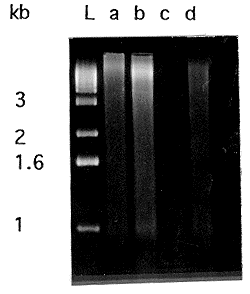
Figure 1. Genomic DNA extracted from 10 mg lyophilized C. immitis after killing with steam. a, b: strain 1; c, d: strain 2; a, c: without Proteinase K; b, d: with Proteinase K; L: 1 kb DNA size ladder (Gibco BRL). Gel was treated with RNAse after electrophoresis.
美国北卡罗来纳大学研究团队研发出一种名为“DNA花朵”的微型机器人。这种机器人具有独特的自适应环境变化能力,能够像生物体一样,根据周围环境改变形状和行为。“DNA花朵”机器人由DNA与无机材料结合形成......
瑞士苏黎世联邦理工学院科学家在最新一期《自然》杂志上发表论文称,他们开发出一款名为MetaGraph的DNA搜索引擎,能快速、高效地检索公共生物学数据库中的海量信息,为研究生命科学提供了强大的专业工具......
究竟是什么让人脑与众不同?美国加州大学圣迭戈分校研究团队发现了一个名为HAR123的小型DNA片段,这将是解开人类大脑独特性之谜的关键。相关研究成果发表于新一期《科学进展》杂志。最新研究表明,HAR1......
究竟是什么让人脑与众不同?美国加州大学圣迭戈分校研究团队发现了一个名为HAR123的小型DNA片段,这将是解开人类大脑独特性之谜的关键。相关研究成果发表于新一期《科学进展》杂志。最新研究表明,HAR1......
基因组编辑技术作为生命科学领域的一项重要突破,为基础研究和应用开发提供了技术支撑。以CRISPR及其衍生技术为代表的编辑系统通过可编程的向导RNA引导Cas9等核酸酶靶向基因组特定位点,被广泛应用于特......
神经元中基因编辑的插图。图片来源:杰克逊实验室哪怕在五年前,人们也会认为在活体大脑中进行DNA修复是科幻小说中才有的情节。但现在,科学家已能进入大脑、修复突变,并让细胞在整个生命周期中维持住这种修复效......
国际知名学术期刊《自然》北京时间7月2日夜间在线发表一篇基因组学论文称,研究人员从上埃及Nuwayrat地区一个古王国墓葬中提取到一名古埃及个体的全基因组测序数据,这些数据分析可追溯至古埃及第三至第四......
在一项研究中,科学家对埃及一座墓葬中的一名古埃及人进行了全基因组测序。这些数据可追溯至古埃及第三至第四王朝,揭示了其与北非及中东地区,包括美索不达米亚古人群的亲缘关系,为早期埃及人的遗传多样性研究提供......
近年来,环状单链DNA(CssDNA)因其稳定性高、免疫原性弱、可编程性强,成为基因调控、细胞治疗等医学合成生物学领域很有潜力的分子工具之一。近期,中国科学院杭州医学研究所研究员宋杰团队针对此前开发的......
随着信息技术的飞速发展,传统存储方式已经逐渐无法满足大数据时代的需求。在此背景下,DNA信息存储技术应运而生,通过利用DNA分子存储数据,已经被视为未来大规模数据存储的潜力介质。每克DNA能够存储数百......