
We have developed a method for isolating high quality total RNA from N. crassa mycelia that reliably yields large quantities. It is possible to extract more than 50 minipreps at once.
Procedures of RNA extraction published so far follow roughly three different approaches, where phenol/chloroform, guanidinium salts, and/or LiCl is used. However, these protocols have some disadvantages. They are either time consuming, or yield low amounts of RNA, or are not powerful enough for cultures containing high levels of nucleases. Extraction from starved cultures or plate mycelia with the LiCl method (Chambers and Russo, Fungal Genet. Newsl. 1987. 33:22-24) gave completely degraded RNA as judged by gel electrophoresis. In trying to improve the method we modified the protocol used for Chlamydomonas by Gromoff et al. (Mol. Cell. Biol. 1989. 9:3911-3918) who combined the advantages of phenol extraction and LiCl precipitation. The procedure is suitable for rapidly grown mycelia, starved mycelia, mycelia from plates (4 days old) and single colonies of N. crassa grown on a sorbose plate. With this protocol, from 20 to 300 mg (dry weight) of mycelium, grown in liquid media or on plates, yielded between 200 µg and 3 mg of RNA depending on the growth conditions and strains. From a single colony we could isolate up to 5 µg total RNA.
Mycelium from a liquid or surface grown culture was harvested, washed, dried thoroughly with filter paper and frozen in liquid nitrogen. Single colonies including agar were stamped out using an inverted Pasteur pipette and frozen.
The procedure of extraction given below is described for Eppendorf tubes but it is also possible to scale up the volumes. All manipulations were performed at room temperature if not stated otherwise.
- Pulverize the mycelium in a mortar with liquid nitrogen
- Transfer the powder into a mixture of 0.75 ml lysis buffer (0.6 M NaCl, 10 mM EDTA, 100 mM Tris HCl, pH 8.0, 4 SDS) and 0.75 ml phenol (saturated with 0.1 M Tris HCl, pH 8.0) in a 2 ml Eppendorf tube. The tube can be filled with powdered mycelium
- Shake for 15-20 min (Eppendorf Rotationsmischer 3300)
- Centrifuge for 10 min, 10,000 rpm
- Transfer the upper phase into an equal volume of phenol (saturated with 0.1 M Tris HCl, pH 8.0) and vortex
- Centrifuge for 10 min, 10,000 rpm
- Add 0.75 volumes of 8 M LiCl to the upper phase
- Store overnight at 4°C
- Vortex briefly and centrifuge for 10 min, 10,000 rpm
- Resuspend the pellet, which is not always visible, in 0.3 ml double distilled water, mix with 0.03 ml 3 M Na-acetate (pH 5.2) and 0.75 ml ethanol
- Store at -20°C for 2 h or at -70°C for 30 min
- Centrifuge for 10 min, 10,000 rpm
- Discard the supernatant and wash the precipitate with 70 ethanol
- Dry the RNA pellet and redissolve it in DEPC treated (diethyl polycarbonate) water
- Store the RNA solution at -70°C
Purity of the RNA preparations was assayed by spectrophotometric measurements. The A260/A230 and A260/A280 ratios were 2 or more, indicating the absence of any protein or polysaccharide contamination. Usually, traces of DNA present in RNA preparations can be seen in the slots of ethidium bromide stained formaldehyde gels. Based on this criterion, RNA samples prepared by the described method were free from contaminating DNA, while clear nondegraded ribosomal bands were seen in all 200 extractions we made (see Figure 1). Northern blot analysis by hybridization with several 32P-labelled probes (Figure 2) and in vitro translation experiments (Figure 3) have shown clear signals indicating the presence of intact mRNA.
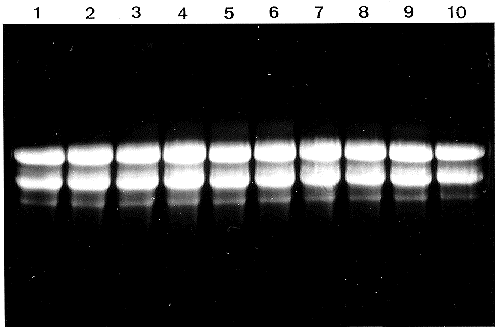
Figure 1. Total RNAs (10 礸 per lane) from 10 different preparations (lanes 1-10) were electrophoresed on a 1.2 agarose gel containing 2 formaldehyde. Visualization was done by staining with ethidium bromide and irradiation with UV. The major bands correspond to 28S and 18S rRNA, faint bands to 23S, 16S and 5S rRNA.
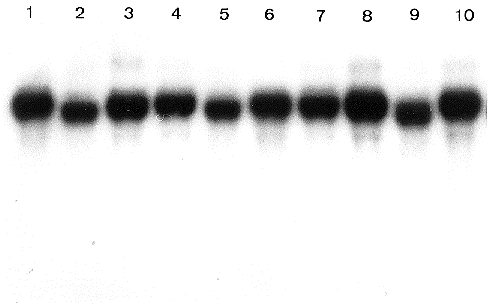
Figure 2. Autoradiogram after Northern blotting and hybridization to 32P-labelled cDNA insert of arbitrarily chosen clone N6 (T. Sommer et al. 1989. Nucl. Acids Research 17:5713-5723). Northern analysis was done according to R.A. Kroczek and E. Siebert 1990. Analyt. Biochem. 184:90-95.
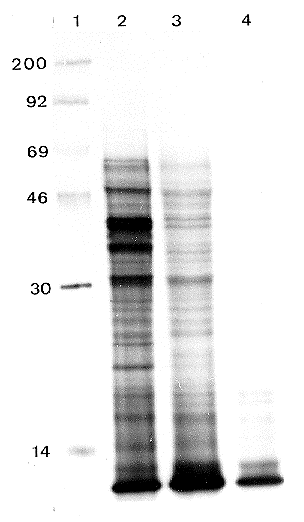
Figure 3. SDS-PAGE (12.5) of 35S-methionine-labelled in vitro translation products. Lane 1: 14C-labelled marker proteins, molecular wieghts are indicated on the left (Mr x 10(-3). Lanes 2 and 3: RNA prepared from mycelia grown in rich or ammonium depleted medium respectively. RNA probes correspond to lanes 1 and 2 in Fig. 1 and 2. Lane 4: control translation without RNA.
Acknowledgements: We thank Beate Otto for in vitro translation experiments and Niketan Pandit for critically reading the manuscript.
近期,由中国科学院紫金山天文台牵头,新疆天文台、上海天文台,以及北京大学、南京大学等单位联合开展的500米口径球面射电望远镜(FAST)银道面中性氢巡天启动试观测,基于新扫描模式获取的巡天数据取得新突......
据27日《自然》杂志报道,英国伦敦大学学院(UCL)化学家通过模拟早期地球的条件,首次实现了RNA与氨基酸的化学连接。这一难题自20世纪70年代以来一直困扰着科学家,如今,这一突破性成果为解答生命起源......
美国芝加哥大学团队开发了一种更为灵敏的液体活检技术,该方法利用RNA而不是传统的DNA来检测癌症。这一创新方法在使用患者血液样本进行测试时,识别出早期结直肠癌的准确率达到95%,显著优于现有的非侵入性......
浩瀚银河系内,大多数恒星成对出现,以双星系统的形式共同演化。这一系统如何交互和演化,一直是天文学领域的前沿难题。近期,中国科学院国家天文台研究员韩金林带领的科研团队利用灵敏度极高的中国天眼FAST,发......
由新加坡科技研究局基因组研究所领导的科学家团队,发布了迄今全球最大、最全面的长读长RNA测序数据集之一——新加坡纳米孔表达数据集(SG-NEx)。这一成果有望解决疾病研究中长期存在的技术瓶颈,使研究人......
4月15日,中国工程院院士、中国科学院亚热带农业生态研究所首席研究员印遇龙领衔的单胃动物营养研究团队在科技合作和成果转化上取得新进展。其团队博士生王芳以“RNA技术研发与产业化应用”为主的项目,历经初......
近日,中山大学生命科学学院教授张锐团队首次提出名为MIRROR的全新内源性ADAR招募gRNA设计理念,显著提高了RNA编辑效率,这一突破为RNA编辑技术走向临床应用注入了强劲动力,同时也为相关疾病的......
中国科学院分子细胞科学卓越创新中心陈玲玲研究组揭示了双链RNA依赖的蛋白激酶R(PKR)在阿尔茨海默病(AD)发生与进展过程中异常激活的分子病理特征,开发了基于具有分子内短双链结构环形RNA(ds-c......
在癌症治疗领域,化疗药物耐药性问题一直是阻碍治疗效果提升的关键瓶颈。癌细胞拥有多种复杂的机制,能够巧妙地逃避化疗药物的“攻击”,其中,高活性的抗氧化系统可以有效减轻药物诱导的活性氧(ROS)损伤,成为......
比利时布鲁塞尔自由大学主导的一项研究揭示,DNA和RNA的表观遗传学协同调控比过去想象的更加紧密。这项发表在最新一期《细胞》杂志上的研究,结合了DNA和RNA研究结果,指出这两种调控方式共同作用,形成......